THE SHARK THEORY

I have always said that I wasn’t afraid of anything. Not the dark, not ghosts, not danger. I grew up believing that fear belonged to other people, that it was something noisy and dramatic, something that announced itself loudly, demanded attention, and left visible marks behind. I never thought it applied to me.
Except for one thing.
Sharks.
I grew up in Bodrum. When I was a child, my father used to swim far out into the bay. He was enormous back then, tall and wide, a man whose physical presence felt permanent, almost geological. He had a Mongolian figure, sharp monolid eyes that carried a yellow, sunlit gaze, the kind that made you feel protected just by standing near him. He would lift me onto his back and swim for ten or fifteen minutes, until the shore blurred into a thin line of sound and color. Then he would stop in the middle of the sea, leave me floating with my pink inflatable armbands, and continue alone toward a small island.
I would wait there for him so we could return to shore together. Sometimes I played by myself for minutes that felt like hours. The sun sat directly above my head, heavy and white, the water glittering beneath me. I traced circles on the surface with my fingers. I imagined my fingertips as small mermaids diving into the sea, limited only by how deep my arms could go before the balloons pulled me back up. Some days I put my head under the water and practiced holding my breath, again and again, trying to see the sea floor while floating above what must have been twenty meters of depth.
I remember waiting like that on another day, floating and watching my father grow smaller in the distance, aware of the space between us but not yet capable of naming what that distance meant. Then, at some point, something brushed against my ankle. It was cold, smooth, alive, and fast.
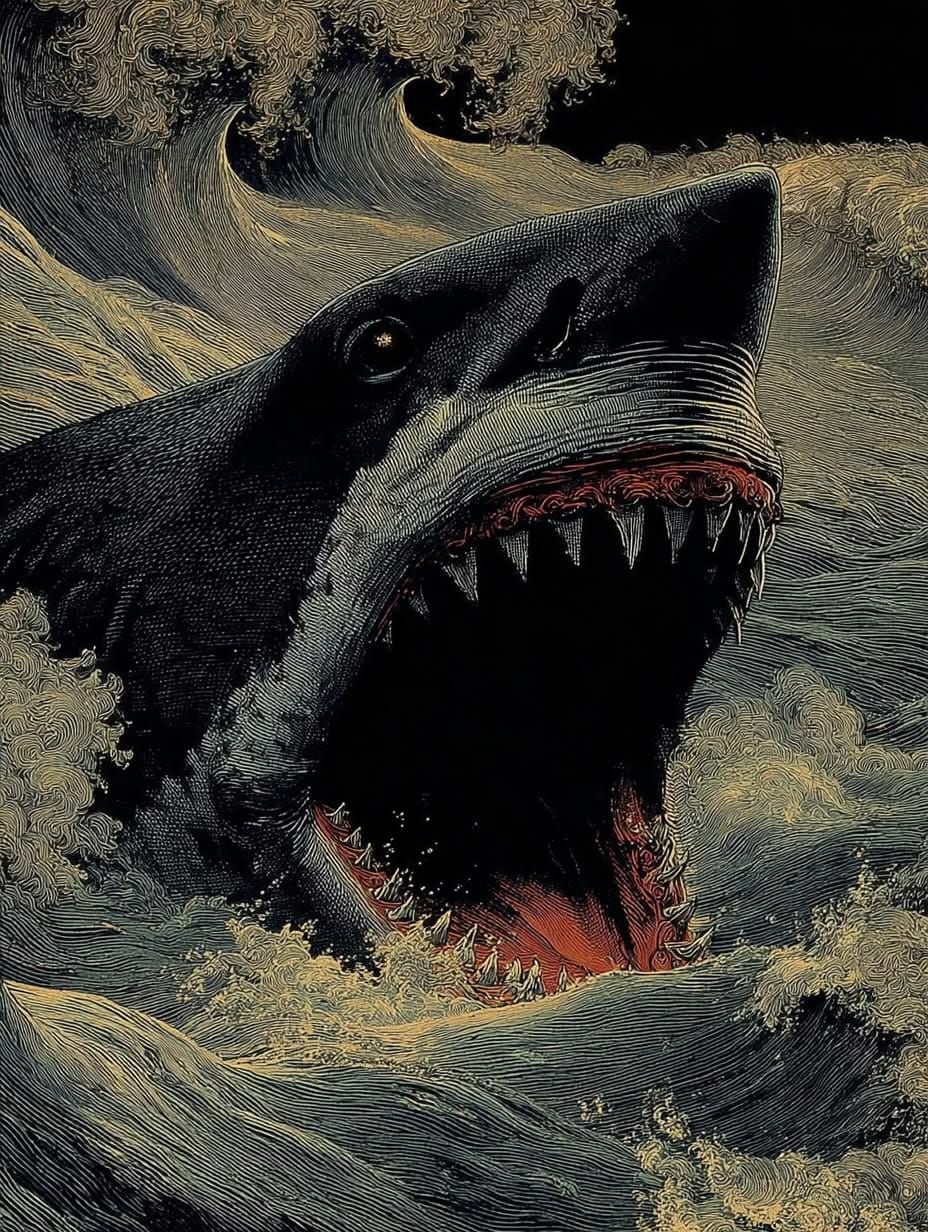
I have a little brother with an obsession with sharp teeth, which meant I knew all about sharks and dinosaurs long before I understood fear. Enough to recognize what had touched me almost immediately. In the first few seconds, when the realization hit, I didn’t scream or thrash. I didn’t panic. I simply opened my mouth, and everything went black.
I woke up on the sand with strangers standing around me. My father was still far away, swimming back slowly, disciplined, steady, as if nothing had interrupted his routine, as if the day had continued exactly as planned. I didn’t cry. I didn’t want to disappoint him. I acted strong and fearless, even then.
It was the first time in my life I tasted loneliness.
I had learned something heavy that day, something that settled deep in my chest, even though I didn’t yet know how to name it.
Something that would face me years later. Something I carried far longer than I realized.
I refused to go into the sea for almost a year after that. My younger brother invented games to distract me so no one would ask why a child raised on a half island avoided the water. Eventually, without remembering the moment I decided, I went back into the sea again. I don’t remember choosing it. I just remember being there. That moment, being forced to face a fear without anyone holding your hand, became a small reference point in my life.
Life moved on. Years passed. The memory stayed, stored somewhere quiet.
When I left Qatar, I didn’t know if I would return or when. I didn’t tell anyone I needed a new start. I called my assistant Gizem, twenty-two years old, the sweetest girl, and asked her to come stay in my house to take care of Marcel while I was away. I told her I was traveling for work, that I needed an air change. I didn’t announce anything to myself either.
I packed lightly. I booked the ticket the same day. I let momentum decide the rest.
Thailand happened that way. Two minutes between opening the app and confirmation. No ceremony. No reflection. Just movement. I needed to get out of my depression and find the version of myself I had been forcing into old routines. I was ready to meet her without pressure, to get to know her instead of disciplining her like a strict parent.
Phuket hit me immediately. Heat first. Thick, wet air pressing against my skin as if it had weight. The smell of oil, sugar, exhaust, and salt mixed into something sweet and rotten at the same time. Motorbikes everywhere. People laughing too loudly. Music leaking out of places that didn’t need doors.
I checked into a hostel with chipped paint and damp walls. My room smelled like sunscreen and old air conditioning. I loved it. After years of superficial luxury in Dubai and Qatar, I craved feeling human again. Ordinary life. Imperfect things. I dropped my bag on the bed and lay there, staring at the ceiling fan slicing the air into slow circles.
I didn’t talk much at first. I walked. For hours at a time. My bare feet slapped against pavement still warm from the sun. Sweat ran down my back, collecting between my shoulder blades. I bought fruit from street carts and ate it standing up. Mango juice dripped down my wrist. Sticky fingers. No napkins.
At night, I ate pad thai from plastic containers. It became my new hyperfocus food. So many colors, oddly slippery in my mouth, something I didn’t even have to chew. I sat on low stools with my knees pulled in, watching flames jump up from woks as vendors moved their hands with practiced indifference. One evening, a woman at the stall kept glancing at me. Finally, she asked where my husband was.
“I don’t have one,” I said.
She tilted her head. “Why you come alone?”
I shrugged. “Needed to,” I said, then added, “You have good food here. That alone is worth flying miles and not feeling lonely.”
She nodded like the sentence made sense, like she had heard it before. She didn’t ask anything else. I even felt like she wished she didn’t have her husband either. He was sitting on another stool near the entrance, watching a television that played music videos without sound. She handed me the container, still warm, noodles glossy with sesame oil and peanuts, a wedge of lime tucked into the corner. I ate slowly. The heat burned my mouth. I liked that it forced me to stay present.
Days blurred together. I slept too little. Some nights I stayed out until my legs ached. Other nights I went back early and lay in bed scrolling through nothing in particular. I said yes to things without caring whether they meant anything. Sometimes curiosity felt like hunger. Sometimes it felt like boredom.
I met people and forgot their names. Shared cigarettes. Shared laughter. Shared silence. Once, I did something so absurd it barely registered as real. Four girls. A night that made no sense. Sweet, strange, unnecessary. I didn’t regret it. I didn’t understand it either. It happened and passed, like most things there.
One morning, standing outside the hostel with coffee in my hand, a French backpacker looked at me and said, “You look like you think too much. Want to go snorkeling?”
It was five in the morning.
I almost said no. My mouth was already shaping the word. All I wanted was to walk toward Buddha, greet the gods along the way. I had once seen Hanuman and Shiva on that path. I wanted to watch the sunrise and maybe draw a few tourists into my diary. Then I realized I hadn’t really spoken to anyone properly in two weeks. Not just exchanged sounds, but actually talked. I hadn’t spoken French in six years, and suddenly remembering that part of myself felt strange, like recovering a personality trait lost during a long period of narcissistic manipulation and artificial wealth exposure.
So I said yes. Again.
The boat smelled like fuel and wet towels. Everyone was loud, joking, slapping sunscreen onto shoulders and backs. I sat on the edge of the bow with my feet dangling, watching the water slap against the hull. The sea was clear. Too clear. Blue folding into darker blue the farther you looked.
They told us we were heading to a shark point. People laughed nervously. Someone made a joke. I didn’t say anything. It was like I hadn’t even heard it.
We reached a place where blacktip sharks made homes around underwater caves, vast openings carved into the ocean floor. Hammerheads moved in and out of the shadows, appearing and disappearing beneath the boat.
I knew how to handle a boat. That’s a basic life skill when you’re from Bodrum. I still can’t drive a car, but that didn’t matter. What mattered was calculating every possible consequence of turning the boat around, of choosing somewhere that didn’t look like a monster soup from above.
When it was time to jump, my body paused. Not fear. Calculation. Two seconds. Then I went in.
The water closed around me, cool and clean. Sound disappeared. My breathing echoed inside the mask. Below me, a blacktip shark moved through the water with slow, unbothered grace. It didn’t look at me. It didn’t care at all.
I floated there. My body loose. My arms heavy. I realized I wasn’t waiting for anything to happen.
I was just there.
And then I understood something very simple.
It was never about sharks.
My biggest fear was the realization that I had been alone my whole life, and that I could remain alone as long as fate kept running its course. A shark was nothing compared to the idea that when you die, in that singular moment, there is no one to call. That is not a metaphor for my case. No one to depend on. No one to turn your back to when you are tired. No one to call when you are sick. No one to hug when you need it.
The deep, dark ocean of loneliness.
Çok acı.
I was never afraid of sharks. I was afraid of a bigger predator I met as a child. The truth of loneliness. I thought I had managed it well. In reality, I had hidden it under a very tough personality with non-negotiable boundaries so I wouldn’t have to deal with absence of anyone. I acted aggressively independent so I would never have to ask for help. I became a barking dog to survive and forgot that I needed to live instead.
After loosing the most loved and closed ones to me through out the life, I have defended myself by building a walls so thick, I wouldn't be more lonely that I already am. I had to change that, it wasn't healthy or sustainable for human.
I realized I didn’t need to be the shark or the ocean. I had always been the sunlight touching my fingertips between the water’s surface and the deep.
After Thailand, I didn’t go back immediately.
I flew to Seoul.
The cold shocked me first. Sharp air cutting through clothes even in spring. Everything was cleaner. Quieter. The city moved with precision. People knew where they were going. No one looked at anyone else for long. I liked that.
My only negative comment would be that as of all the other Asian country, such a China, Japan or places that are it's neighbours, Korea was the most superficial of them all. A bubble effect was felt too hard, you don't need to have the skills to read common patterns applied throughout the whole society.
I rented a large apartment in Suwon with white walls and traditional architecture. Every morning I walked the same streets, went to the same café, ordered the same drink. The barista drew a smiley face on my cup without asking my name. I sat by the window and watched people pass without imagining their lives. I climbed nearly every mountain in Korea and visited every city except Busan and Jeju. It took me a week with Jaeyong’s car to cross the country. He is a separate story. Kind-hearted, unforgettable, with his dog Kuruma. A phase. A rockstar memory.
In the subway, an old woman touched my arm and told me I looked tired. I nodded. She nodded back. That was all.
At night, I walked until my feet hurt. Neon signs reflected in puddles. My breath turned visible in the air. Sometimes students invited me to sit with them because they found me “interesting.” Sometimes no one spoke to me at all. Both felt fine.
I lost ten kilograms in three months.
I liked being unknown. A body moving through systems that functioned without me. I didn’t have to be anything there.
I was connected to everything and attached to nothing.
But even on good days, I knew Qatar was waiting. Gravity doesn’t disappear just because you step away from it.
When I finally returned, my new apartment felt smaller than I remembered. The air heavier. I unpacked slowly. My cat watched me with eyes that knew everything I have done in the last 6 months. I stood in the kitchen holding a glass of water and remembered the ocean one last time before starting to a new life in the old faces.
Not the shark.
Not the depth.
The waiting.
And something inside me shifted, quietly.