Sky Above, Silence Within

I was raised in a house where religion existed, but no one really owned it.
One of my parents was Alevi - Bektashi, the other Christian, and somehow neither of them tried to pull me fully into either side. There was no quiet fear behind belief, no pressure to choose correctly, no sense that faith was something I had to perform. I could enter a mosque, leave, walk into a church, leave again, and nothing followed me home as an obligation. That absence of pressure shaped the way I relate to belief far more than any specific doctrine could have, because when you are not forced into something, you do not attach to it emotionally first, you start observing it.
At some point, without deciding to, I began to notice structure instead of just meaning. The way authority is built, the way guilt is distributed, the way behavior is shaped through language and repetition. It stopped feeling like something I was inside and started looking like something I could examine from a distance. Not in a cynical way, but in a way that removes fear from the equation. Once fear disappears, analysis replaces it naturally.
But while I was doing that, something else was always present in the background, something that was never formally explained and never defined clearly. It did not belong to a book, and it did not require a place of worship. It appeared in small, almost casual moments, especially when something important was about to happen. Someone would say, “let’s ask,” and that sentence did not refer to a priest or an imam. It referred to something else entirely, something that did not feel separate from religion, but also did not feel contained by it.
A Shaman..
Inside our home, this never felt contradictory. It did not feel like we were combining incompatible systems or creating confusion. It felt older than both Islam and Christianity, as if those belief systems were simply layers placed over something that already existed and continued to operate quietly underneath. We prayed, but we also asked. Not because logic failed, but because it was understood, without needing to explain it, that not everything in life is fully accessible through logic alone.
Turkic culture was considered more precious than any religion. The land comes before your beliefs. Your culture is what makes you a part of your roots.
For a long time I thought this was something specific to my family, something slightly unusual but contained. But later I started noticing the same pattern in other places, especially in Turkey. You walk through a village and see pieces of cloth tied to trees where people leave wishes without needing to justify the act. You visit a grave and notice that people are not only praying, but speaking, as if the dead are still present in a different form. Blue beads hang in homes and cars as protection, not because of a strict religious instruction, but because it is simply understood that they serve a purpose. Certain shrines feel less like structured religious spaces and more like something inherited and adapted over time.
This becomes even more visible in Alevi and Bektashi communities, where Islam exists, but moves differently. It is less rigid, less centered on fear, more symbolic and internal. Music and poetry are part of practice, and ritual feels lived rather than imposed. It does not reject Islam, but it does not fully resemble its orthodox form either. And if you look closely, what appears is not contradiction, but continuity. Something that existed before formal religion, that did not disappear, but was absorbed and reinterpreted within a new framework.
My father used to say something very famous as a quote now ;
Alevism is a strategic perspective of how Anatolia adapted on Islam. It is carried on generations and by the other minorities during Ottoman, including Ottoman.
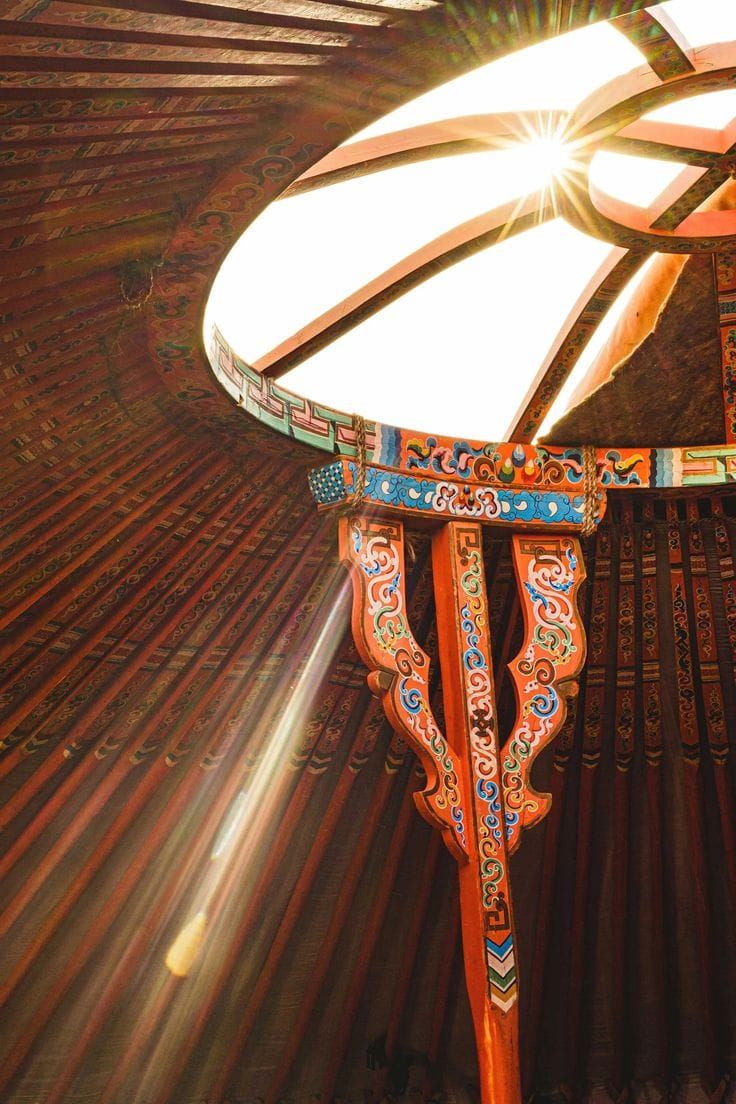
This is where the idea of Tengrism becomes relevant, although even that word feels insufficient once you understand what it points to. It is not belief in the conventional sense, and it is not structured around obedience. It is closer to orientation than to doctrine. The idea that there is sky above, earth below, and the human positioned between them, not as the center of existence, but as part of a larger order and keep the balance between those. Once you recognize that perspective, nature no longer feels decorative. It becomes structural. The sky is not distant, water is not aesthetic, and sunlight is not symbolic in a poetic sense. They are elements of a system you are already part of.
What is interesting is that this recognition does not require abandoning rational thought. It is possible to understand biology, psychology, and physics in detail and still feel that there is a layer of experience that is not captured by those explanations. Not in a mystical or exaggerated way, but in a way that feels stable and familiar, as if it does not need to prove itself to exist.
That same pattern begins to appear in human behavior as well. Certain reactions that feel personal at first start to look less individual when observed over time. The resistance to authority unless it proves competence, the discomfort with submission, the intensity of reaction to humiliation compared to loss. These are not necessarily learned as explicit ideas, and they do not need to be framed as identity or ideology. They can simply be recognized as patterns, shaped over time through environments and conditions that required different forms of adaptation.
When you begin to look at cultures through that lens, the idea of clean, separate systems starts to fall apart. Religion does not replace what existed before it; it absorbs it, reshapes it, and gives it new language. Islam in Turkey is not identical to Islam elsewhere because it carries layers from Central Asian, Anatolian, and steppe traditions. Christianity carries similar adaptations depending on geography. No belief system arrives in a place and remains untouched by it. It changes, even if the change is not always acknowledged.
The reason I was able to notice this is not because I studied it formally, but because I was never required to fully belong to one side. Staying in between created enough distance to observe without needing to defend or reject anything. That position does not create confusion as much as it creates clarity, because it allows you to see what continues underneath different structures without immediately categorizing it.
Over time, that underlying layer stops feeling like something abstract and starts feeling like something consistent. Not something dramatic or mystical, but something quiet that does not require constant explanation. It does not disappear when you question it, and it does not weaken when you analyze it. If anything, it becomes more stable, because it is no longer tied to belief, but to recognition.
And maybe that is the part that remains, regardless of how much you learn, how much you question, or how many systems you move through. Not something you need to define perfectly, and not something that demands attention, but something that continues to exist without needing to justify itself.
"Kök Tengri, endless sky above me,
I stand beneath your order with clarity and humility.
Steady my mind. Strengthen my body.
Guide my path toward rightful success.
I move forward grounded, grateful, awake.
Gün Ata, sovereign of light,
Thank you for your fire and visibility.
Illuminate my work. Sharpen my skill.
Strengthen my will without consuming my spirit.
As you rise without hesitation, I rise with purpose.
Ay Ata, guardian of the night,
Hold me in your quiet clarity.
Calm my thoughts. Steady my emotions.
Teach me patience without doubt.
Surround me with your silver clarity. Watch over my steps as I walk beneath your light.
As you move through cycles without fear, I accept mine with discipline.
Kayra Han, source of will,
I act with structure, not impulse.
My karma is clean, I carry no tears of others on my soul.
Umay Ana, keeper of the unseen,
I grow with precision, not haste.
Yer-Su, earth and water within me,
I remain grounded. I do not leak. I do not scatter.
Be my witness and let me achieve to my existential purpose under your companionship."